Annan History
⏲ ANCIENT: From AD 83 – The Romans >> From AD 600 – Hoddom Monastery ~~~ ⏲ DEFENSIVE: 12th Century – The Bruce Family >> 14th Century – Stapleton Tower >> The Riding of The Marches ~~~ ⏲ ILLICIT: Rabbie Burns ~~~ ⏲ PROSPEROUS: 1757 – 1900 Influential People >> Industries over the years >> The coming of the railway ~~~ ⏲ WARTIME: From 1914 – HM Factory Gretna >> Teetotal Annan! >> War Memorial >> From 1942 – RAF Annan ~~~ ⏲ EXPANDING: From 1959 – Chapelcross ~~~ ⏲ ANNAN’S HISTORY TODAY: Annan Families >> Clubs & Organisations >> Ghosts of Annan’s Past
Ancient Annan
St Kentigern & The Hoddom Monastery
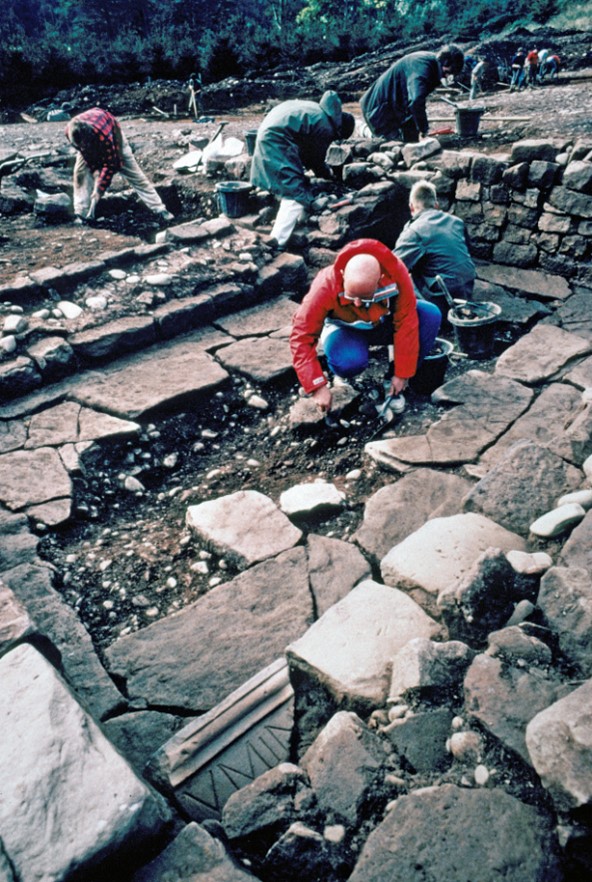
Dr Chris Lowe conducted excavations in advance of sand quarrying on the site of the Christian Monastery at Hoddom Bridge (reported in the DGNHAS Transactions of 1991).

PHOTO Above: The 1991 excavations of the stone structure, inside the monastery’s protective ditch and bank that runs across the top of the photograph. Photo by kind permission of Dr Chris Lowe.
The Monastery History
In about AD 600 St Mungo had built a large monastery with many buildings of timber. For the small chapel and a baptistery, stones from the ruins of the nearby Roman fort at Birrens were used.
Dr Lowe’s excavation plan (1991) from Trans. DGNHAS LXVI
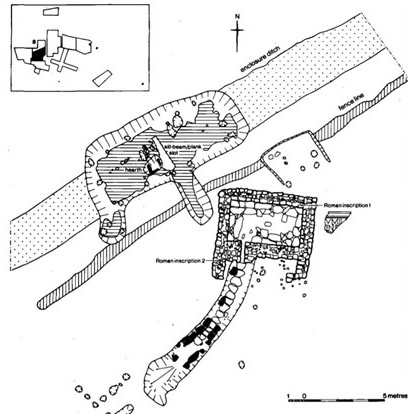
Dr Lowe found the ditch and palisaded bank that protected the site, and several internal structures, many of wood. The most important structure was the rectangular stone building, which sits just inside the defences. It was approached by a curving sunken paved corridor. The heavily paved floor, thick walls and use of clay mortar has led to its identification as a baptistery for immersion baptism.
Two fragments of Roman inscription embedded in the walls confirmed that the building was constructed of recycled stones, carted over from Birrens Roman Fort. Other finds from the site gave dates from the 8th and 9th centuries and later.
Excavations by the Royal Commission in 1915 next to the River Annan had located parts of a small church, now covered by the old graveyard 300 metres east of the bridge. This was also made of stones from the Roman site. In the apse of the chapel was a building inscription of the Sixth Legion (now lost).
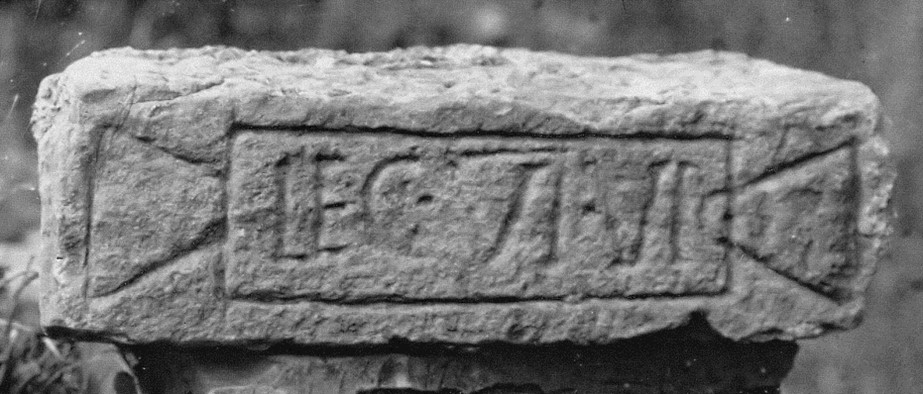
The stone recording work by the Victorious Sixth Legion, from the chancel wall of the early Christian church under the existing graveyard close to the River Annan.
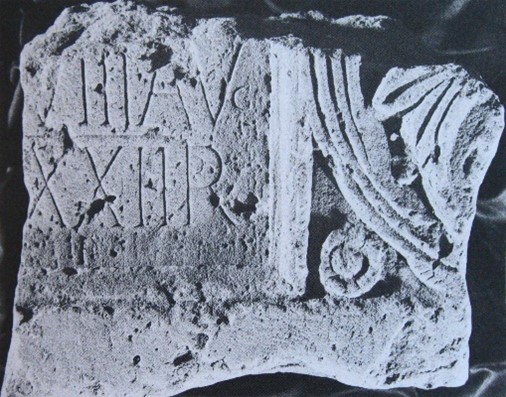
One of the two inscribed stones from the walls of the baptistery, recording work at Birrens fort by detachments from Germany of the Eighth and Twenty Second Legions. The other NVMIN inscription is visible at the bottom of the above excavation photograph.

Part of the centre of a cross depicting Christ in Majesty, photographed at Knockhill. (RCAHM East Dumfriesshire Volume).
PHOTO Below: The baptistery under excavation (D & G Council)
Following the 1640 order by the Church of Scotland for the destruction of all idolatrous depictions of Christ, several early crosses on the Hoddom site of similar style and importance to the surviving Ruthwell Cross were smashed into pieces. Many fragments were later rescued and built into the wall of a summerhouse at Knockhill; these were extracted and transferred to Hoddom Castle for safe storage before the Second World War, but then used as hardcore to widen the east drive of the castle to accommodate tanks.
Their destruction is considered to be the greatest loss of important early mediaeval sculpture in South West Scotland.
Annan and the Kentigern Way
Modern pilgrims walk The Kentigern Way, a relatively new Pilgrim Route leading from Annan, via Hoddom to Glasgow Cathedral.
Kentigern is the alternate name for St Mungo, the patron Saint of Glasgow. He lived in the 6th Century at the same time as St Columba, who when they eventually met encouraged him to travel south from his Glasgow base to carry out missionary activities. He travelled to the Solway Firth estuary where the King of Rheged granted him some land at Hoddam, just North of Annan. After many years in the area, he returned to Glasgow where he was ultimately laid to rest in a tomb in the crypt of Glasgow Cathedral.
The Kentigern Connection
St Kentigern (518 – 603), usually known by his alternative name St Mungo, is the patron saint of Glasgow Cathedral. For some years St Mungo made Hoddom Monastery his Episcopal Seat in the Brittonic Kingdom of Strathclyde, before he finally returned to Glasgow.
More About The Pilgrim Route
The Kentigern Way is a 150-mile walk recreating his route back to Glasgow, taking Annan Old Parish Church as a starting point.
It is a beautiful scenic walk taking in the Annandale Way, Southern Upland Way, the Cross Borders Drove Road, the John Buchan Way and the Clyde Walkway.
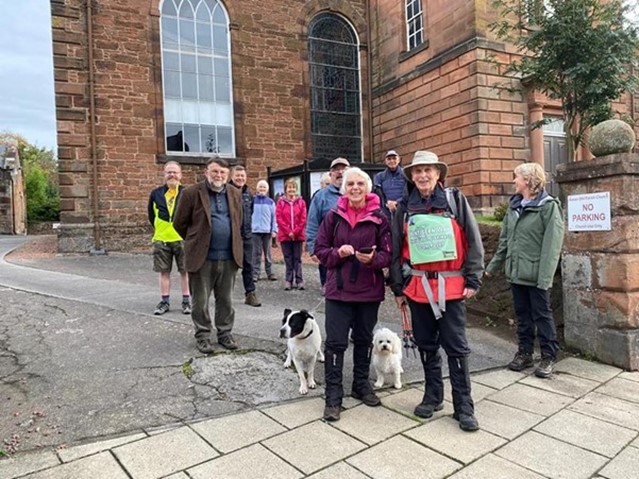
The inaugural pilgrimage started on the 8th of October 2021 with Bill and Christine Jack accompanied by members of the Annan Churches for the Annan to Hoddom stretch. Bill and Christine reached Glasgow Cathedral on the 19th of October where a Service of Dedication for the Kentigern Way was held.
Find out more:
PHOTO Below: Walkers at Annan Old Parish Church on the 8th of October 2021.